
 By Cal Lutheran News
Center for Economic Research and Forecasting delivers thoughtful analysis
The California Lutheran University Center for Economic Research and Forecasting (CERF) is highly regarded for its annual Ventura County Economic Forecast reports and events, where deep-dive data research and the humanistic side of economics combine to present a clear-eyed picture of the county and beyond.
One of the timely themes CERF addressed at its annual Forecast event on Feb. 24 is “Broken Inheritance,” which explored the economic and social costs of government debt, along with how the decisions made now will have unavoidable consequences for the next generations.
At the event, Matthew Fienup, PhD, CERF executive director, also released the 2026 Ventura County Economic Forecast publication, which provides an in-depth analysis of the county’s economic and demographic performance.
This is just the tip of the iceberg for CERF, which is led by Fienup and Dan Hamilton, PhD, an expert on economic measurement. As a team, they’re fleet-footed, dynamic and responsive. Their thoughtful policy analysis provides a much larger impact on the community, region, state and nation than larger, institutional forecasting organizations.
It’s on the forefront of asset-minded framing with its annual U.S. Latino GDP Report and its groundbreaking 2025 Bank of America U.S. Latina GDP Report. These highlight how the Latine population is a tremendous asset that’s worthy of investment because there will be a return on that investment.
In 2025, CERF added quarterly reports with timely analysis on the latest data releases. And it launched a brand-new website CLUCERF.org to serve as an information hub. The public can access the site’s blog, which has thought-provoking, informative articles on current topics.
Launched in 2009, CERF has emerged as one of the nation’s most accurate economic voices, winning multiple Crystal Ball awards for the Fannie Mae Home Price Expectations Survey, earning nationwide recognition for forecast accuracy, and becoming a growing influence in state and local policy debates.
The center does this by being contrarian in the best way possible — conducting rigorous research and making “predictions of what we think is most likely to happen, not what we want to happen,” Fienup said. “We’re unconventional in our forecast and still really, really accurate.”
The process involves continuous questioning, applying economic theory and running multiple models and forecast combinations. “Doing multiple forecasts allows us to do scenario forecasting. It asks, ‘What happens if this policy changes or that?’ And then the economic theory piece often highlights variables that we put a lot of weight on that other people don’t.”
As one of the nation’s top experts on economic measurement, Hamilton plays a key role in helping CERF stand out among the crowded field of economic forecast organizations in the country. For example, when forecasting home prices, Fienup explained, you’re not actually forecasting home prices. You’re forecasting the government’s measurement of home prices. “Understanding how it’s measured is key to forecasting the value,” he said.
Another component of CERF’s research methodology is that “we spend as much time looking backward and studying our forecast errors as we do looking forward,” Fienup said. “In fact, we probably spend more time looking back analyzing our forecast errors than we do looking ahead and trying to understand why we got it wrong. And asking, ‘What needs to change?’”
CERF is a member of the prestigious Wall Street Journal Economic Forecasting Survey, the National Association for Business Economics Economic Outlook Survey and the Fannie Mae (formerly Case-Shiller) Home Price Expectations Survey.
When it comes to Ventura County, CERF’s research focus goes beyond black-and-white numbers. “That’s because it’s been about just relentlessly telling the story, the data reveal and then trying to humanize it,” Fienup said. “These are our neighbors; these are coworkers. It’s about making a difference in the lives of our fellow community members.”
CESI explores California’s housing crisis and its future
The Center for Economics and Social Issues (CESI) hosted its annual conference Feb. 19, analyzing why millions of California families struggle to afford safe and stable housing despite living in one of the world’s most prosperous places.
The conference, “California’s Housing Crisis: Roots of the Problem and What Lies Ahead,” examined how the state’s economy allocates housing resources and what policy solutions can help families thrive.
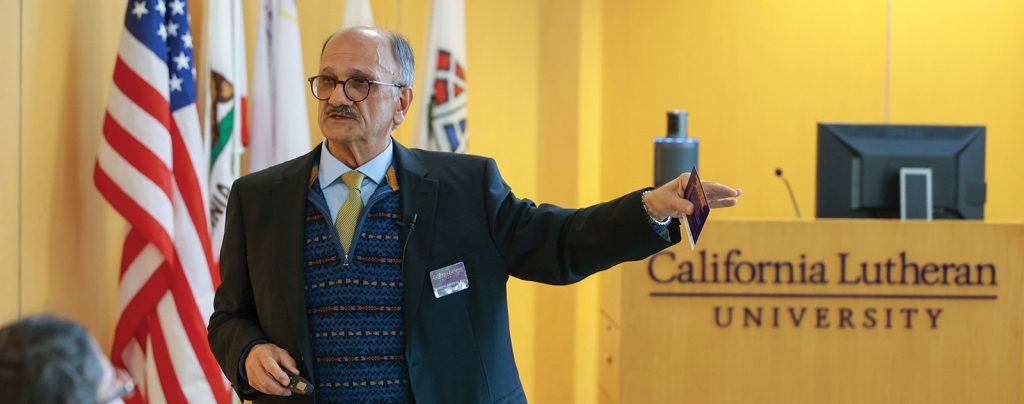
Community members, local leaders, nonprofits, businesses and policy experts gathered at Lundring Events Center to discuss solutions. Jamshid Damooei, CESI’s executive director and economics professor, presented CESI’s findings with Sabith Khan, Master of Public Policy and Administration program director, and Ruslan Korchagin, a Cal Lutheran doctoral student in Higher Education Leadership.
The annual meeting builds on CESI’s recent research, including its 2025 report, “Undocumented but Indispensable: Updated Findings on Their Economic Impact in Ventura and Santa Barbara Counties,” that found undocumented immigrants directly contribute approximately $5.8 billion to Ventura and Santa Barbara counties’ GDP.
The study also found that 73% of undocumented renters in Ventura County are financially burdened by housing costs, with 39% spending more than half their income on rent.
“The interest in the economic impact of undocumented immigrants is very high at present,” Damooei said.
CESI’s research on housing affordability and economic impact provides a well-rounded picture of the challenges facing California families and aims to inspire residents and lawmakers to act on meaningful solutions.
University receives nearly $3 million in grants in 2025
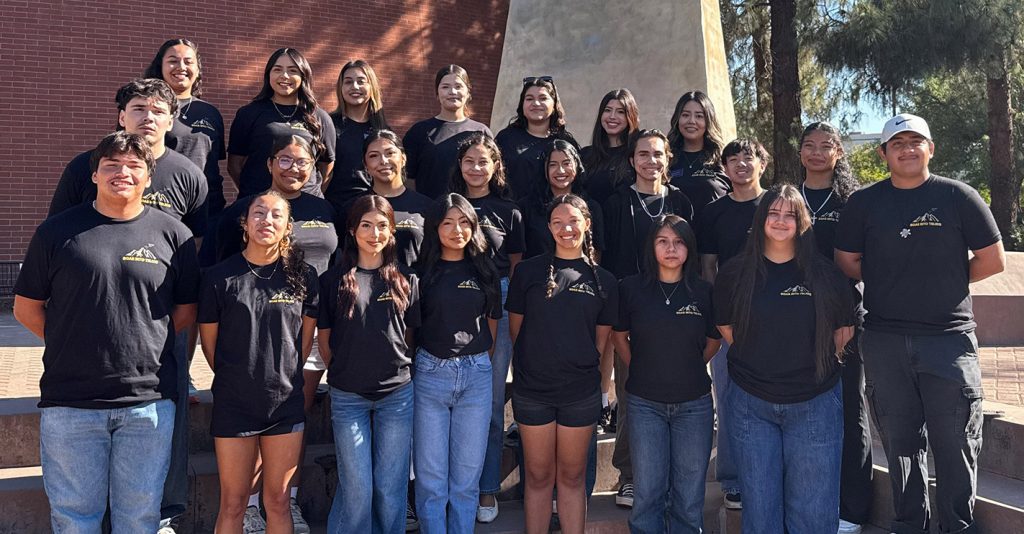
Cal Lutheran secured almost $3 million in grant funding in 2025, supporting students facing financial challenges and advancing faculty research.
“Cal Lutheran is more than a place of working and learning; it is life-giving,” President John A. Nunes said. “To that end, grant funding is an important way for us to strengthen our connection to our community and to provide life-giving academic tools for our students.”
The TRIO Student Support Services grant funded through the U.S. Department of Education has been renewed through 2030. The five-year grant of $1,540,875 will serve 206 undergraduate students annually.
Katherine Hoffmann, an associate professor in chemistry, and her colleagues secured $917,066 in combined funding from the John Stauffer Charitable Trust and the National Science Foundation’s Chemistry of Life Processes Program for research examining enzymes that contribute to bacterial virulence.
Other contributions included $200,000 from the G.A. Foster Legacy Foundation to help fund the Violet and Gold scholarship, which offers vital financial assistance to students, and to facilitate repairs to the roof of Samuelson Chapel. An additional $90,000 from the Ahmanson Foundation was awarded to the Financial Aid office in scholarships for students living in Los Angeles County.
University Advancement also raised a record-breaking $601,180 during its annual Giving Tuesday campaign on Dec. 2. This year’s Cares Day 2026 is scheduled for April 8, and members of the Cal Lutheran community are invited to invest in the university’s mission.