
 By Mark Wyckoff
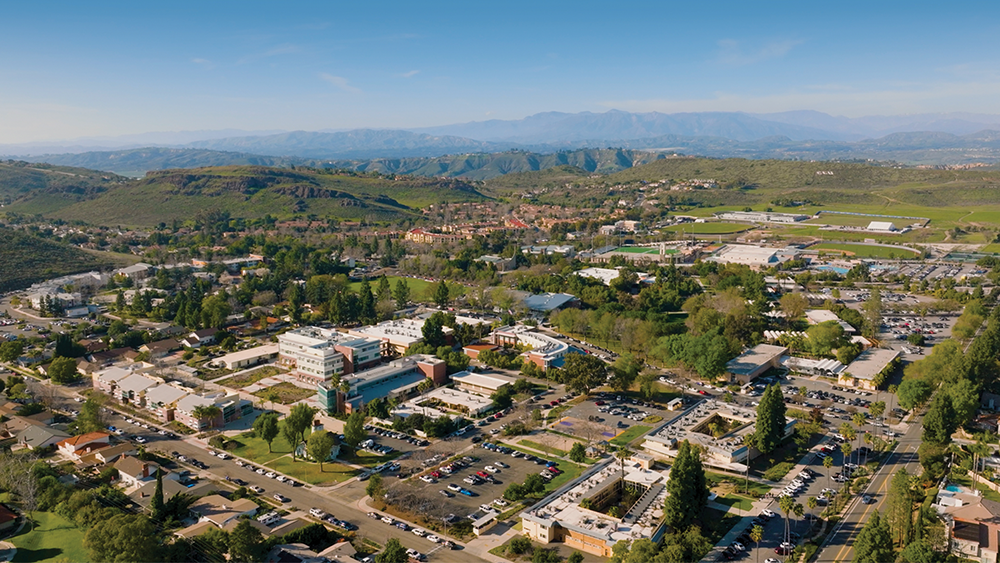
More than 450 California Lutheran University students were packed inside Samuelson Chapel to hear Nobel Peace Prize Laureate Malala Yousafzai, but to senior Hope Gonzalez, it felt as if the 28-year-old Pakistani education activist was speaking only to her.
Gonzalez, set to graduate with her bachelor’s degree in business administration this week and an MBA next spring, was particularly taken by Yousafzai’s definition of bravery.
“She said that if you’re anxious, it doesn’t mean that you’re not brave,” Gonzalez said. “Bravery is being OK with being scared, but still going ahead and (accomplishing your goals).”
Those sentiments resonated so deeply because Gonzalez, who wants to become a brand marketing director, said she has struggled with anxiety herself.
“My parents always tell me that you’re still brave even when you’re anxious, and hearing Malala onstage say those words, I feel like that phrase will stick with me forever,” Gonzalez said. “I feel like it was exactly what I needed to hear, and I felt like she was saying it just to me.”
Throughout her 90-minute appearance on May 9, Yousafzai projected quiet yet forceful confidence as she shared inspiring words about the importance of education, gender equity and the steely resolve needed to make transformative changes in your life and the world. The invitation-only audience was composed primarily of female student-athletes and female business students, along with faculty members and campus leaders.
In his opening remarks, Cal Lutheran President John A. Nunes said Yousafzai “embodies everything we believe in at Cal Lutheran: courage, resilience, transformation, vocation and the power of education to change lives.”
He said her story is not merely one of survival.
“It’s about what you choose to do after you survive,” he said. “It’s about refusing to let fear or hatred win. It’s about believing that education is not merely a privilege, it’s a human right. And it’s about using your voice, no matter how young, no matter how dangerous, to build a better world.”
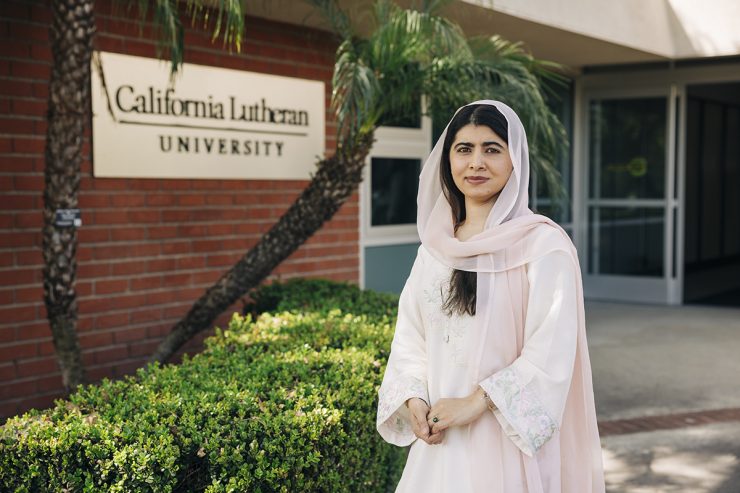
The audience erupted into applause as Yousafzai stepped onto the chapel stage. Wearing a cream-colored shalwar kameez (a traditional Pakistani outfit featuring a long tunic and loose pants) and a pale pink headscarf, she held her hand to her heart as she soaked in the love.
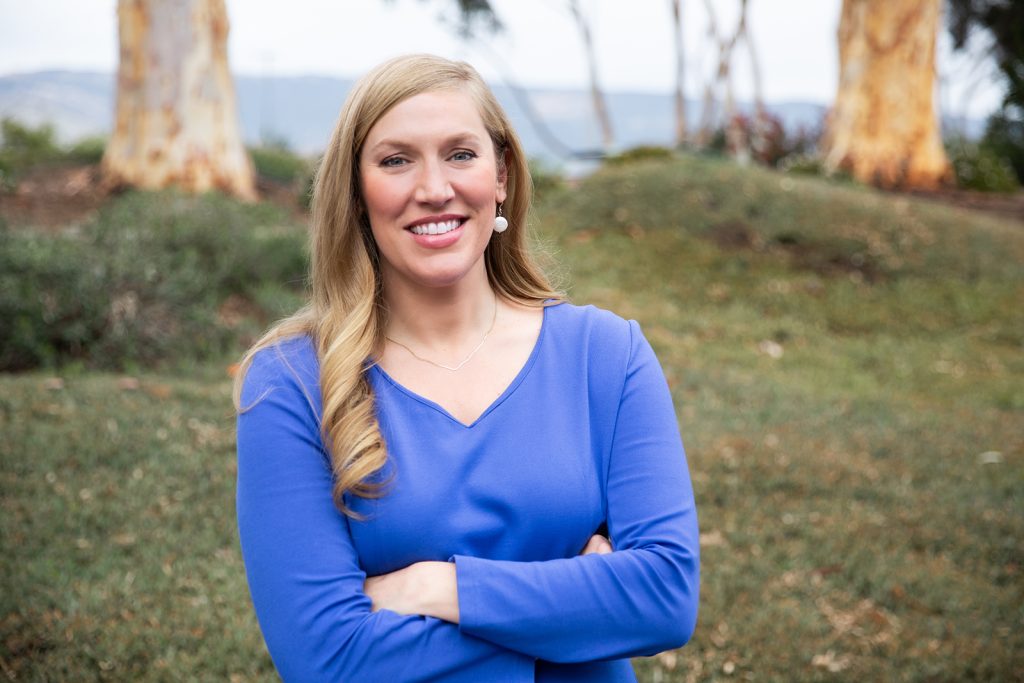
Billed as a “Fireside Chat,” it was a casual conversation between Yousafzai and the event’s moderators: entrepreneur Andrea (Villasenor ’23) Brimmer, the CEO of a Los Angeles-based agricultural technology company called Rivida, and Angel City Football Club (ACFC) CEO Julie Uhrman, whose National Women’s Soccer League team trains and practices at a nine-acre site on campus.
Brimmer began by asking about the attempted assassination, which happened in 2012 when Yousafzai was just 15 years old. The Taliban considered her a threat because, from the age of 11, she had spoken out loudly and eloquently against its brutally misogynistic efforts to deny girls an education.
“I didn’t feel like I had a choice,” she said. “I couldn’t imagine a life without education.”
To silence her, a masked Taliban gunman jumped aboard her school bus and shot her in the head point-blank.
“I always tell people that the Taliban made a mistake,” Yousafzai said. “They shot the wrong person. Because today I’m no longer fighting for my own right to go to school, I’m fighting for the 122 million girls who face barriers to education.
“This has been the journey of my life.”
That journey has gradually evolved as she found her voice and honed her message on the world stage. While recovering at a British hospital following the shooting, Yousafzai — who now lives in England — founded the nonprofit Malala Fund in 2013 to advocate for a world where all girls can learn and choose their own future. The following year, when she was just 17, she was awarded the Nobel Peace Prize. She was busy learning about particles and atoms in her high school chemistry class when the news was announced.
As fellow students gathered around to offer congratulations, they said, “Everyone wants to hear from you. Are you going to hold a press conference?”
She shook her head.
“I was like, ‘No.’ I have to finish my studies,” she said. “So I went back to class. Because when you get a Nobel Peace Prize for education, you have to finish your studies.”
Even as she hit the books at England’s University of Oxford — graduating in 2020 with a degree in philosophy, politics and economics — the youngest Nobel laureate in history continued to fight to ensure that all girls receive at least 12 years of education.
That remains her overarching goal, but she’s allowing herself to dream bigger and to find different ways to fight for inclusion, tear down gender stereotypes and provide girls with more opportunities to chart their own destiny.
She’s pushing for the international community to formally recognize the Taliban’s systematic oppression of women and girls in Afghanistan as gender apartheid. And, in her latest pivot, the lifelong sports enthusiast is teaming with her husband, Asser Malik, to form a private equity firm dedicated to funding women’s sports. It’s called Recess Capital, and it’s designed to promote equality by expanding athletic opportunities for girls.
“I remember recess time at my school in Pakistan when boys would go off to the local cricket playground, and girls had to stay behind,” she said. “I want recess to look very different for the next generation of girls. And that can only happen if we invest in women’s sports, if you create those opportunities.”
In Yousafzai’s view, the success of teams like ACFC is just the beginning. When asked by Uhrman to describe the future of women’s sports in one word, Yousafzai didn’t hesitate.
“Unstoppable!”
With the right mindset, Yousafzai believes anyone can be unstoppable. It’s something she discovered several years after the shooting when she began therapy to deal with post-traumatic stress disorder. One of the problems she faced was that she felt extremely unworthy when people called her brave or courageous for standing up to the Taliban. She appreciated the compliment, but could she really be brave when she felt so scared inside?
“That’s when it hit me — and it’s helped me redefine my beliefs,” she said. “Bravery is not a behavior where you have absolutely no fear at all. Real bravery is when you keep doing what you believe in, even when you’re scared. So in moments when I feel anxious, I actually work twice as hard.”
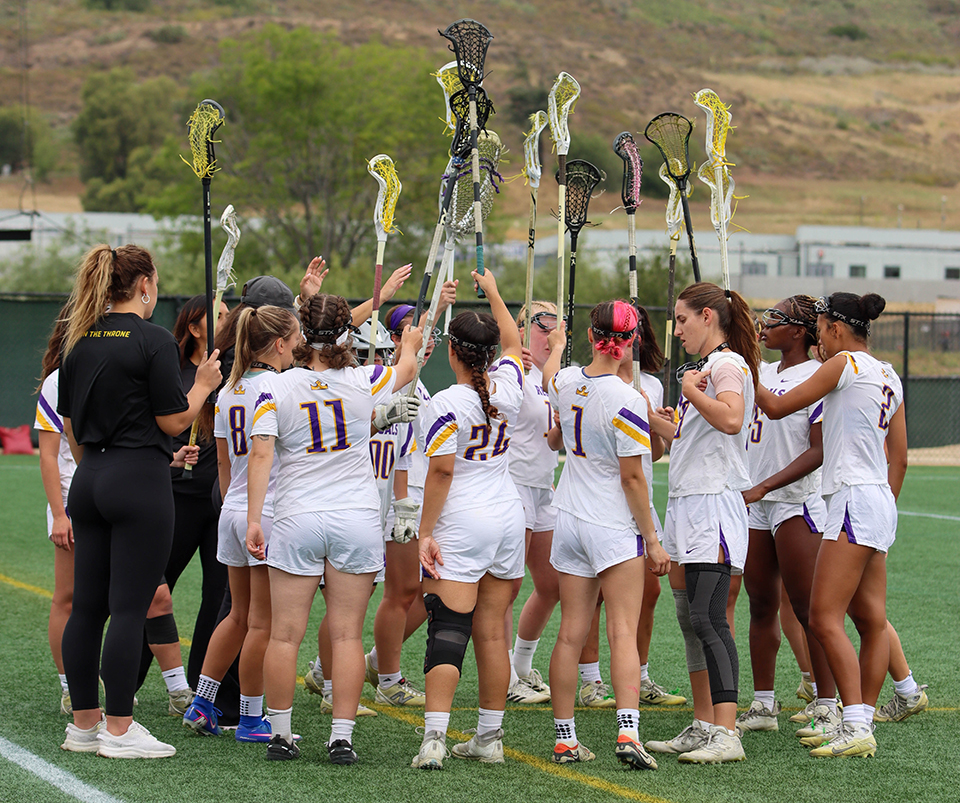
Like Hope Gonzalez, first-year biology student Emily Raich found these words inspiring, not only as a student but because she has the opportunity to expand gender equality as a member of Cal Lutheran’s new flag football team.
“After seeing Malala today, what’s set in my mind more than anything else is that nobody’s going to tie me down or hold me back,” Raich said. “I’m going to take every opportunity I can, especially with flag football. I’m just going to work as hard as I can because these are opportunities that girls in other places of the world aren’t getting. They’re opportunities that should be fought for, so it’s my job to fight for them.”
Raich said she’s going to take Yousafzai’s words to heart as she competes on the football field and works to forge a career in medicine, perhaps as a veterinarian or an ultrasound tech.
“As a woman in sports, as a woman in STEM, as a woman who wants to go into the medical field, I am scared there’s going to be a lot coming my way these next years,” Raich said. “But being scared isn’t what defines you. What you do and how you (overcome) those fears is what makes you who you are. I think that her saying that is all I needed.”
Three microphones were set up in the chapel so students could pose their own questions.
Anya Seifert, the student manager of Cal Lutheran’s women’s basketball team, asked Yousafzai what she would say to American students who are losing hope in a liberal democracy.
“The setbacks that you are experiencing right now are actually a reminder that maybe things weren’t as stable as you thought they were,” Yousafzai responded. “Maybe things weren’t really as progressive. Unless you work together to guard democracy and hold the perpetrators accountable, anybody in the world can be banned.
“But if enough of us come together and make a commitment to see systemic change, we can make the world a better place and a better society.”
Maddi Lee, a senior majoring in liberal studies in education, asked the final question: “What parts of home do you take with you every day?”
“That’s a beautiful question, and thank you for asking,” Yousafzai said. “I used to say that home is always my home. I grew up in a beautiful valley in northern Pakistan. … But I’ve also traveled around the world. … So when I get asked about home, I have lots of homes. I feel a sense of home when I’m in the company of my college friends. I feel a sense of home when I’m with my family members. I feel a sense of home when I’m with my husband. All of the incredible people who are around me give me that sense of home. Yes, home is a place. The place matters. But it’s also the people. They can help you have a sense of home around you.”
Yousafzai’s final message was about hope.
“What I have learned is that it’s so important for us to understand that hope is not a feeling. We can’t wait for it to come to us,” she said. “We can create hope by starting with something, by walking together, and by staying ambitious.
“I want you to understand that you have so much power in your voice, in your actions. And even if you don’t have a lot of answers, but if you start with something, and you join hands with others, and you dream to stay ambitious, you will create hope, and you will lead towards the change that you want to see.”
After a boisterous standing ovation, Yousafzai shook hands with Nunes and began to exit the chapel. Then she turned back toward the crowd.
She wanted a group photo so she could remember the afternoon.
For Yousafzai, this wasn’t just another personal appearance. It was a chance to revel in the power of education surrounded by women who embrace learning and athletics as much as she does.
“I think it was nice for her to learn more about exactly what’s going on with female sports as she begins her work with Recess Capital,” said co-moderator Brimmer, who majored in business administration while at Cal Lutheran. “She also got to learn about what this generation is interested in.”
As she helped lead the onstage conversation, Brimmer said it was tough not to cry as she looked out at all the students with smiles on their faces.
“It was just like a wave of inspiration,” she said. “Just truly pure inspiration.”