

 By Cal Lutheran News
The diagnosis was gut-wrenching: kidney cancer. But even at his most vulnerable, when Lance Orozco had every right to keep this life-changing moment to himself, he decided to share the news with his listeners on KCLU Radio (88.3 FM).
It was 2012 and Orozco was already more than a decade deep into his career as news director at California Lutheran University’s public radio station. He had chronicled the wildfires that tore through Simi Valley and Moorpark in 2003, the heartbreak felt at Ronald Reagan’s Simi funeral in 2004 and the Metrolink train crash that killed 21 Ventura County residents in 2008.

“I always ask people to tell these stories about themselves,” Orozco said. “And I just thought, ’Well, maybe this would be an interesting story.’”
He recorded the sounds of his surgery on a digital recorder, then pressed record again two weeks later when his doctor informed him that the tumor removed from his kidney was cancerous. The gripping audio made his on-air report compelling and deeply personal.
The story had a happy ending: The disease hadn’t spread and there was no need for chemotherapy. Listeners who heard the story on air and online were riveted, and some reached out for advice.
“I probably talked to a half dozen people who were in the same boat,” Orozco said. “They were just like, you know, ‘Can I talk to you?’ They wanted to know what to expect and what it was like.”
It’s this kind of informative storytelling that has made Orozco one of the most lauded journalists in Ventura County and transformed KCLU into the No. 1 news station in Ventura and Santa Barbara counties, according to the spring 2025 Nielsen Audio ratings. He’s taken home more than 110 Golden Mike Awards from the Radio and Television News Association of Southern California and two national Edward R. Murrow Awards.
Orozco spent nearly two decades as a reporter and weathercaster for ABC, CBS, NBC and Fox television and radio affiliates in Santa Barbara, Sacramento, Los Angeles and other cities before KCLU Radio General Manager Mary Olson convinced him to become the nonprofit station’s news director in 2001. “Lance is the best hire of my 40-year career,” Olson said.
“His whole focus and goal are, ‘How can I tell community stories? How can we serve the community?’ He is tireless in his efforts … not just getting the story but getting the story right.”
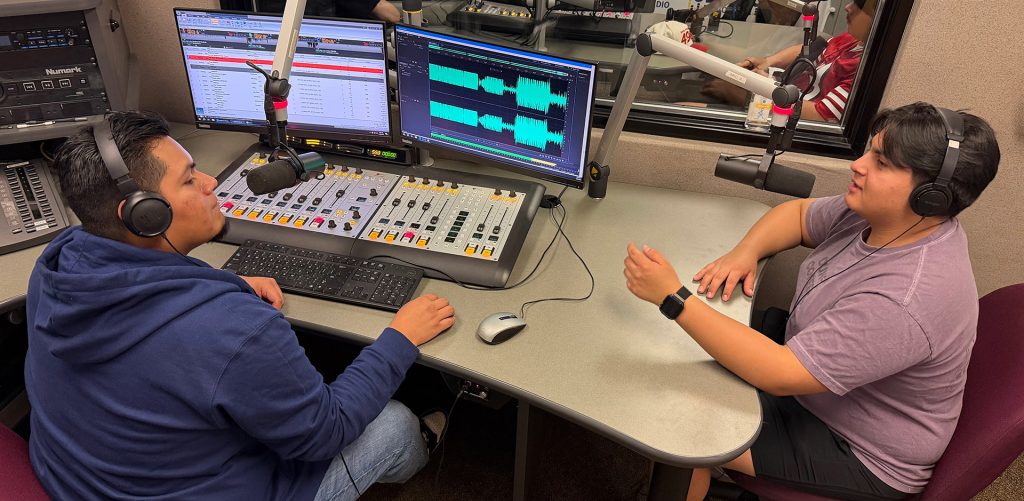
When California Lutheran’s Board of Regents established KCLU Radio in 1994, the station promised “news, culture, controversy, fun and contemporary jazz” as well as National Public Radio programs like Morning Edition, Fresh Air and All Things Considered. After Orozco joined seven years later, the station began focusing more on in-depth local coverage. It has since grown from one signal to six and can be heard all the way from Westlake Village in the south to San Luis Obispo in the north. More than 130,000 people listen every week.
In 2003, when the Simi/Moorpark fire broke out and started destroying homes, Orozco didn’t hesitate: He began doing live coverage on KCLU. The station soon developed a reputation as a trusted source for local breaking news, delivering in-depth coverage of the December 2017 Thomas fire and the aftermath of the Montecito mudslides. Orozco filed live reports from the chaotic scene of the 2018 mass shooting at Borderline Bar and Grill in Thousand Oaks, then quickly shifted gears when the deadly Hill and Woolsey fires broke out the following day.
“It was crazy because we basically had two national stories going on in our backyard at once,” he said. “I worked about 36 hours straight.”

The job can be physically and emotionally taxing, but the Glendale native said it’s a crucial public service. He’s 68 now and has no plans to retire.
“There’s always going to be a need for people to do what I do because people want to know what’s real, what’s verified, what’s been checked,” he said. “I think the people who listen to KCLU listen because they have confidence in what they’re getting from NPR and what they’re getting from us locally is accurate.”
This year marks a milestone for Orozco: his 25th as news director at KCLU. The big issues he’s monitoring include the economy, the cost of housing and how the crackdown on immigration is affecting the farming community. But mixed in with these weighty issues will be lighter stories — like the one he did on the giant fiberglass rabbits known as Conejo Cottontails that are on display throughout the county.
“It’s not an earthshaking story, but it’s a story that hopefully made a few people smile. One of the problems with media is the stuff that makes big news is negative. And that’s not the world. Our lives are not all negative. There’s a lot of good things going on in this community, and I love to be able to share those things.”
How to help
Until 2025, KCLU Radio relied on a mix of listener donations and federal funding to pay for its nonprofit operations. But after Congress voted to defund National Public Radio and the Public Broadcasting Service, the station now faces a $300,000 annual shortfall.
To make up the difference, KCLU General Manager Mary Olson is relying on listeners to “put their money where their ears are.”
“If you appreciate long-form journalism, if you appreciate that the community has an alternative source for news, then we ask people to please support this unique, special thing called public radio on KCLU,” she said.
Olson’s not worried so much about the short term as she is about what will happen down the road. That’s why’s she’s creating a Resiliency Fund program to encourage donors to make financial commitments to KCLU Radio for three to five years.
To make one-time donations or contribute to the Resiliency Fund, visit kclu.org/donate.