
 By Sarah Graue
For the Rev. José Martín Matos Hernández, growing up in the small coastal town of Cabo Rojo, Puerto Rico, meant seeing the effects of climate change everywhere: eroding coastlines and rivers, drying freshwater sources, and rising temperatures that affected his elderly neighbors.
Yet the people in this remote community — located two hours from San Juan, the island’s capital — maintained a deeply rooted connection to nature.
“In such a small town, so far from the metropolitan area with many limitations, nature became entertainment for anyone,” Matos Hernández said in Spanish [author’s translation]. “It’s a place for recreation, where families gather and where you go to work.”
Their bond with nature was tested in 2017, when Hurricanes Irma and María struck just weeks apart, devastating the region and triggering a widespread humanitarian crisis. Years later, the island’s water infrastructure remains at risk, with contamination threatening aquifers and the fishing industry.
In communities like the ones where Matos Hernández ministers, faith provides a source of hope for people experiencing the toll of climate change. Building on this reality, the Center for Climate Justice and Faith at Pacific Lutheran Theological Seminary launched its Spanish-language certificate program in 2023, delivered fully online.
Religious leaders from Latin America, North America and the Caribbean are among those participating in PLTS’s two-semester certificate program. The program builds on the center’s English-language initiative, which more than 144 leaders from 32 countries have completed since its inception in 2021.
“All participants, in a way, have been a witness to some kind of environmental degradation and political opposition to climate justice,” said the Rev. Neddy Astudillo, MDiv, program coordinator for the Spanish-language certificate. “Our participants are seeing the threat of climate change that it poses in their communities, and are trying to figure out, ‘What can I do?’”
Astudillo, who was born in Venezuela and has over 40 years of pastoral experience, says the continuing education program is designed for those on and off the ministry track. Some are pastors leading congregations or lay leaders in churches, while others are community organizers or activists seeking to learn ecology and live in harmony with God’s nature.
“We believe in a God that is a loving God, that cares for the world and invites all of us to have abundant life, including animals and all creatures,” Astudillo said. “We see the need to seek justice and to protect life.”
Guided by instructors, participants learn about the realities of the climate justice movement, recognizing that climate change is not experienced equally: The groups least responsible for greenhouse gas emissions are often those who have suffered socially, politically and economically.
At the start of the first semester, participants find their personal story within the larger global movement by writing an ecological autobiography, integrating their experiences and prior teachings from school and church into a narrative.
“We start our program with that because we want people to connect from the heart, from the start,” Astudillo said. “This is not an issue that we study about; this is an issue that is impacting our lives.”
The program then shifts into the structural causes of climate change, exploring the devastation, exploitation, colonization and historical explanations of the crisis. From there, instructors invite participants to open Scripture and study the Bible through the lens of an environmental concern.
Thanks to Zoom, participants meet biweekly to discuss these concepts.
“Meeting students from other countries who are working toward the same goal helps them feel less alone,” said the Rev. Ángela Trejo Haager, an instructor in the Spanish-language program and coordinator from Seminario Luterano Augsburgo in Mexico.
To best understand these regions, the center partners with seminaries across Mexico, El Salvador, Argentina, Uruguay, Costa Rica and Puerto Rico, alongside the Evangelical Lutheran Church in America and the Lutheran World Federation, to advise curriculum and connect new participants.
“The churches and institutions that support us are very important, as they provide us with human resources and concrete experiences of how they have worked on the issue of climate justice,” Trejo Haager said.
Although the certificate is earned online, its impact is anything but virtual. In the program’s second semester, participants engage with their faith networks to complete a Sacred Action Project, a unique, hands-on campaign tailored to their environment’s needs.
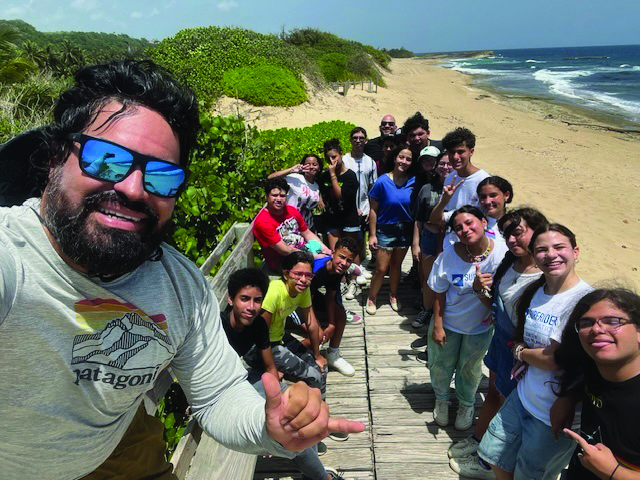
From leading beach cleanings, painting murals and organizing eco-spiritual walks on university campuses, all projects are rooted in community engagement.
“We try to move people away from individual acts of climate justice, because in reality, for climate justice to happen, we need to move to collective action, collective power, and build community,” Astudillo said.
At the forefront of Matos Hernández’s project was the movement closest to his heart. He sought to mobilize his congregation, Christian Church (Disciples of Christ) in Sonadora, Guaynabo, to advocate for the protection of the San Juan Bay Estuary, an ecosystem of freshwater sources that extends nearly 16.5 miles along the coastline.
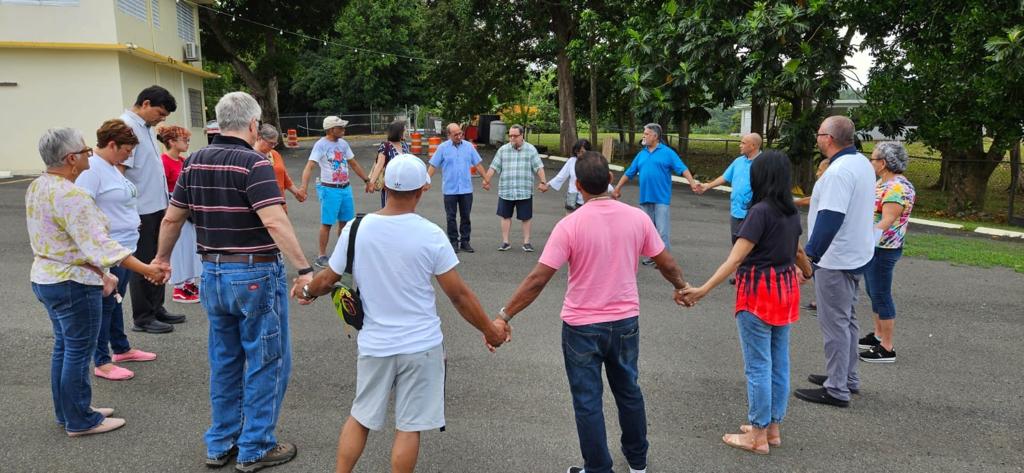
His project, “Walking in Hope,” launched a mentoring program for regional activists, raising awareness of water protection. With his congregation, he organized a weeklong youth gathering that immersed participants in disadvantaged communities to experience firsthand the challenges and realities they face.
“For me, as a Christian, water represents life, cleansing and purity,” Matos Hernández said. “This experience confirmed for me that, although the struggle for climate justice may vary by region, at its core, it is about caring for creation — protecting all that our Lord has made.”
By promoting monthly meetings, delivering informative lectures, and accompanying community members in prayer, follow-up, and care, Matos Hernández led a movement that was embraced by his neighbors.
“My commitment to supporting marginalized communities has illuminated realities along my journey that require attention and action,” Matos Hernández wrote in his final presentation for the program. “This journey has taught me that hope and solidarity intersect and can coexist even in the most challenging situations.”
The experience also gave him a support system that helped prevent the occupational burnout often experienced by activists. By seeing other Sacred Action Projects, based in other parts of the world, Matos Hernández was left inspired, as everyone is “fighting the same battle to defend and protect nature.”
For readers interested in making a difference in their community, the Center for Climate Justice and Faith is committed to making its lessons accessible to all. The center hosts a series of past workshops on its YouTube channel, available for anyone interested in hearing from climate justice specialists.
“When the students send their photos, videos and narratives, it is incredible to see how much they can achieve,” Trejo Haager said. “These kinds of efforts generate much more hope and encouragement to keep going.”
Since completing the program in fall 2024, Matos Hernández said he remains committed to climate justice and brings lessons and insights to his ministry daily. With his congregation, he organizes pilgrimages and prayer gatherings for fellow activists in faith communities.
He has also mobilized his network, going so far as to present proposals and resolutions to government leaders, legislators and senators in Puerto Rico. “A verse that has been a constant guide and source of inspiration in my writings and presentations is Amos 5:24: ‘But let justice roll down like waters, and righteousness like an ever-flowing stream.’”