
 By Cal Lutheran News
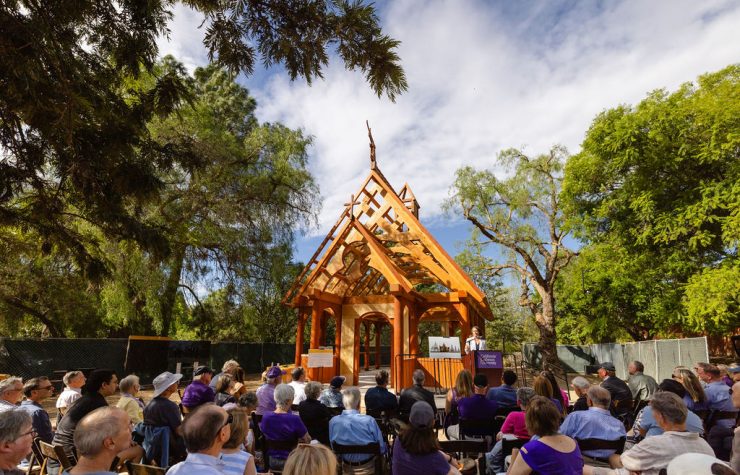
Carved dragon heads extend from a steep roofline, reminiscent of the carvings that once adorned Viking ships. Beneath them, heavy timber posts and arched wooden supports frame a new open-air space designed for gathering, learning and reflection at California Lutheran University.
The James M. Hage Pavilion, unveiled during Homecoming Weekend on Oct. 17, brings centuries-old Scandinavian architectural traditions to a contemporary campus setting, creating a new landmark that celebrates Cal Lutheran’s Norwegian roots and welcomes future generations.
At the event themed “Celebrating a Legacy. Building the Future,” the community honored James M. Hage, whose vision inspired the pavilion, and the generosity of the James M. Hage Trust that funded the construction and continued maintenance of the structure.
“This pavilion reflects and connects students and faculty as a gathering place for future generations,” Cal Lutheran President John Nunes said.
Inspired by Norway’s Stave Churches
The pavilion’s design draws inspiration from Norway’s Borgund Stave (pronounced “stahv”) Church, built around 1180 and known for its distinctive medieval timber architecture. Its upright wooden posts, steep, layered roofs and intricate carvings reflect generations of Scandinavian craftsmanship.
At Cal Lutheran, selected elements of this tradition have been adapted into a contemporary, open-air structure. The result is a gathering place that draws on Scandinavian architectural traditions while serving the university’s educational mission.
The details carry meaning. The carved dragon heads along the roofline evoke imagery from an era when older Norse traditions intersected with the spread of Christianity. The rooster that will top the pavilion will recall the biblical account of Peter denying Jesus three times before the rooster crowed.
Professor of religion and woodworker Samuel Thomas, who co-created the dragon carvings with studio partner Patrick Baguinon of CNC Woodworks, sees their significance extending beyond their historical origins.
“They represent a period in transition that can help us navigate our own period of change with openness and trust,” he said. The symbols offer a reminder of how Cal Lutheran can honor its heritage while remaining open to new perspectives.
As a new campus landmark, the pavilion exemplifies how history informs the present, how different traditions can enrich understanding and how knowledge can be put in service to others.
That balance of tradition and innovation also guided the design and construction. Christine Cano, MPPA ’19, Cal Lutheran’s capital projects architect, described the extensive collaboration that brought the pavilion to life.
“The project brought together craftspeople, faculty, staff and community members, with extensive research guiding the design,” she said.
Watch: Constructing the Hage Pavilion
Rooted in History, Built for the Future
The pavilion’s Scandinavian influences highlight Cal Lutheran’s own beginnings. In 1890, Norwegian immigrants Lars and Karn Pederson joined other families in purchasing land in the Conejo Valley, where they established a farm. In 1957, their son Richard donated his 130-acre ranch to create a Lutheran college.
As Cal Lutheran grew from that land, its Norwegian roots have remained part of its history and identity. The Hage pavilion brings that heritage into a new setting as an outdoor classroom and gathering place. Rooted in Lutheran tradition, it invites people to explore questions of meaning, purpose and justice while learning from a range of religious and secular perspectives.
The materials themselves add another layer of meaning. Thomas sourced the wood for the dragons and the cross above the entrance from an urban timber reclamation partner.
“I knew that whatever we got would have a story, but I didn’t know exactly what that story would be,” he said.
He later learned that the redwood tree used in the project stood at the east entrance of Folsom Prison for more than 100 years, and the symbolism was powerful.
“This tree that stood watch over generations of physically incarcerated people will stand watch over generations of students in search of other kinds of freedom,” he said. “And we hope … freedom that always bends back around in service to the neighbor, to the creation, and to a more just and loving world.”
For James M. Hage, the pavilion was an opportunity to connect his Scandinavian heritage with a lasting contribution to Cal Lutheran. A distant descendant of a medieval Norwegian prince, Hage was affectionately nicknamed “the Prince of Norway,” said Matt Pressey, trustee of the Hage estate. Scandinavian cultural networks and relationships were especially important to Hage, whose interest in Norway’s architectural heritage helped inspire the project.
Through the generosity of the James M. Hage Trust, Hage’s vision has become part of campus life, creating a lasting place for students, faculty, staff and visitors to gather and learn.
“This facility will be something that continues to honor his legacy for many years,” Pressey said.