
 By Martha Groves
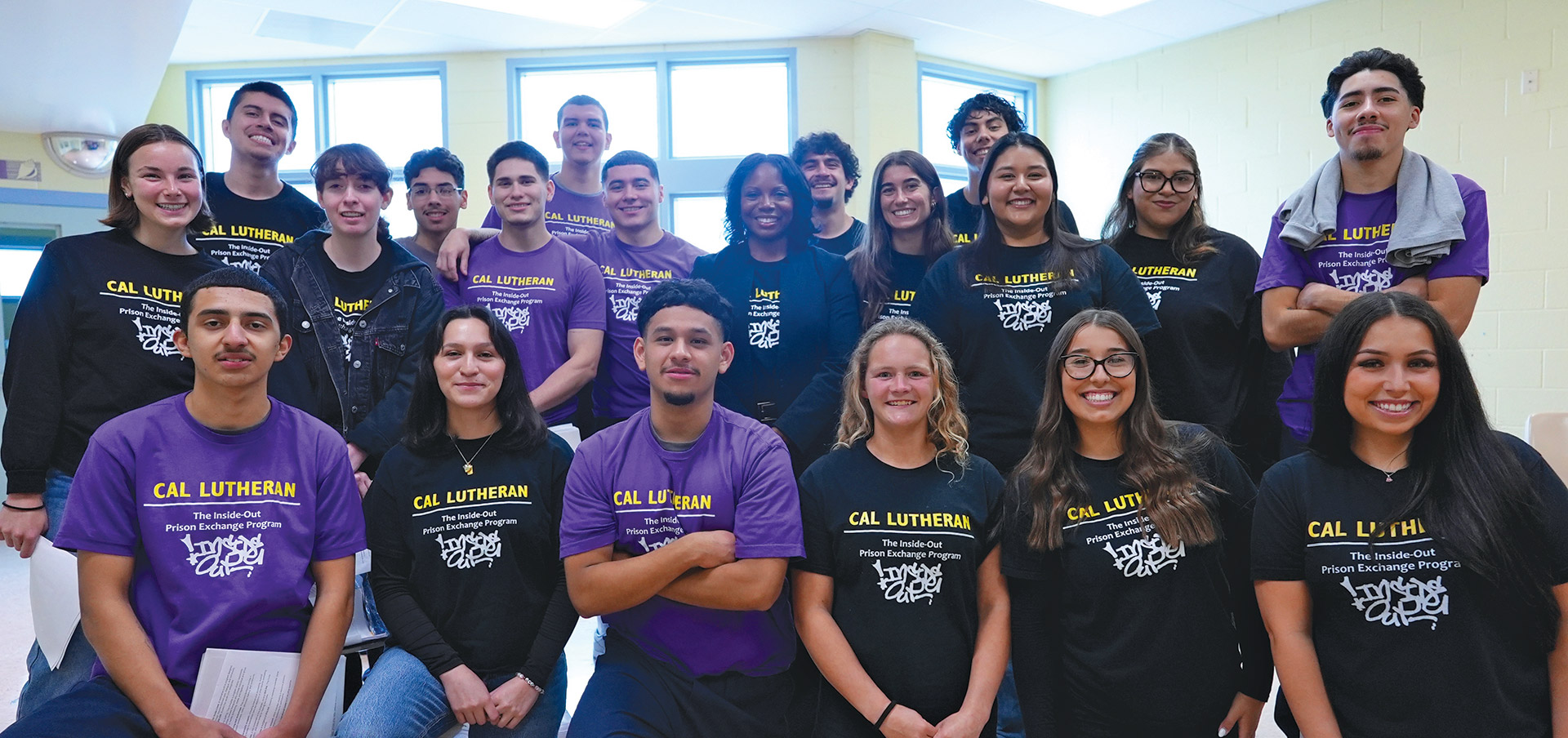
On a Thursday afternoon in May, 20 California Lutheran University students sat in a circle inside the Ventura County Juvenile Facilities compound in Oxnard.
Nine of them wore purple T-shirts. These were the “insiders,” incarcerated young men ages 18 to 25 who had committed serious violent crimes.
The others wore black T-shirts. They were “outsiders,” full-time students attending Cal Lutheran in Thousand Oaks.
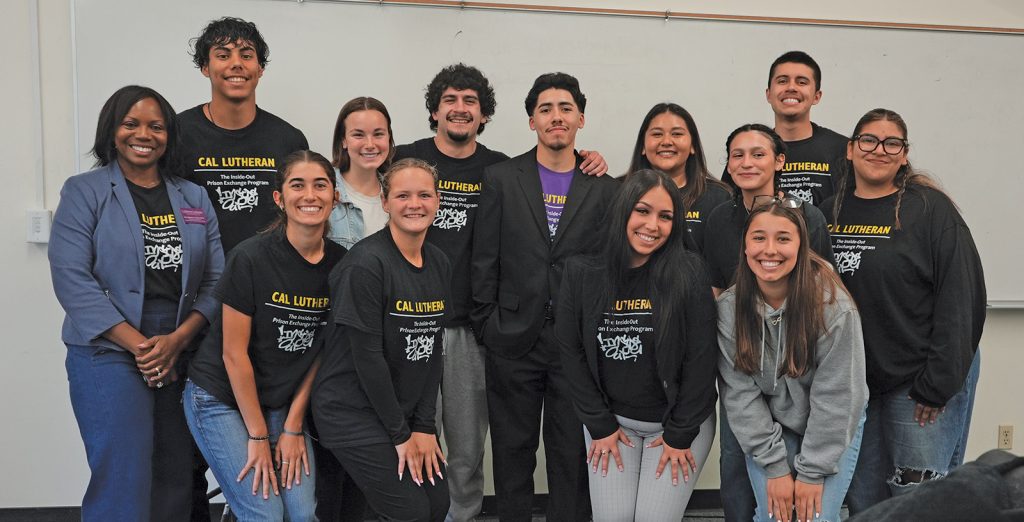
Whether purple or black, the T-shirts carried the same message on the back: “Moving beyond the walls that separate us.”
The students were participating in the Inside-Out Prison Exchange Program, an international initiative that has won praise for its trailblazing approach to education about and rehabilitation within the justice system.
“They are peers who are learning as college students together,” said Schannae L. Lucas, PhD, a Cal Lutheran professor who chairs the Criminology and Criminal Justice Department and led the class during the 16-week spring semester.
In this session, near the end of the semester, the students conversed comfortably with one another about various aspects of the criminal justice system, including trauma, victimization and rehabilitation. The easy collaboration marked a big improvement after the initial jitter-filled classes when trust was at a minimum and “insiders” made assumptions about “outsiders” — and vice versa.
The aim of the Inside-Out program is to foster dialogue about the criminal justice system, enabling people behind locked doors and those free to roam to collaborate on ways to improve it and to prepare incarcerated individuals for re-entry into society. Course topics included the role of prisons, the reasons people commit crimes and the long-term effects of crime on victims’ families.
Participants read three books: Just Mercy: A Story of Justice and Redemption by Bryan Stevenson; Crime and Punishment in America by Elliott Currie; and Race to Incarcerate: A Graphic Retelling by Sabrina Jones and Marc Mauer. They wrote papers that included passages and citations from the books that were particularly meaningful to them.
Throughout, a key focus was public interest lawyer Stevenson’s watchword: “Each of us is more than the worst thing we’ve ever done.”
Many of the “insiders,” who may enroll in the class if they have completed high school or received a GED, come from backgrounds “with traumas and triggers,” Lucas said. “If you’re told you’re bad, you internalize that label.”
Alex, 19, an insider who grew up in Oxnard, said he had been incarcerated for four years.
“This is like the first real learning experience I’ve ever had,” he said of the class, with no hint of hyperbole.
Class sessions featured abundant emotion, often tears. Many of the “insiders” were, for the first time, grasping how to interact respectfully with others. The course challenged their assumptions that Cal Lutheran students are rich and entitled. Some of the “outsiders,” they learned, also had experienced trauma and hardship.
“It took strength and courage to open up to us,” said Anthony, an “insider” who has been incarcerated for about six years. “They do care. The teacher cares.
“This is the first time I’ve felt like a student,” he added. “I felt normal, like a human again. These [‘outsiders’] are college-level kids. I’m right there getting the same grades as them.” He said he hopes to take more college classes once he is released.
Many of the “outsiders” said they hope to become probation officers, public interest attorneys and advocates for youth to help promote restorative justice — a concept that considers the harm done by offenders and strives to bring together victims, offenders, law enforcement and the community to make amends.
Lori Pompa, an instructor at Temple University, is the founder and director of the Inside-Out program. In 1995, she led a group tour at a state correctional institute in Dallas, Pennsylvania. After the tour, the group sat down to speak with five men who had been incarcerated for many years. One man, Paul, suggested she consider spooling out such conversations with students over the course of a semester.
In 1997, she presented the idea to the Philadelphia jail system, and the Inside-Out program was born.
“We sat in a circle,” Pompa said. “The whole focus is on dialogue — and getting away from the usual didactic approach. Really grappling with ideas gets people thinking and learning.”
The program from the get-go was fabulous, Pompa said, “but it was much more fabulous than I had even anticipated. In addition to talking about criminal justice issues, we were learning about ourselves and other people and assumptions and working through conflict.”
Lucas learned about the Inside-Out program at a conference years ago. She had led prison and jail tours for students in her corrections and family violence courses, and she quickly realized that the Inside-Out program could help students delve more deeply into the field of criminology.
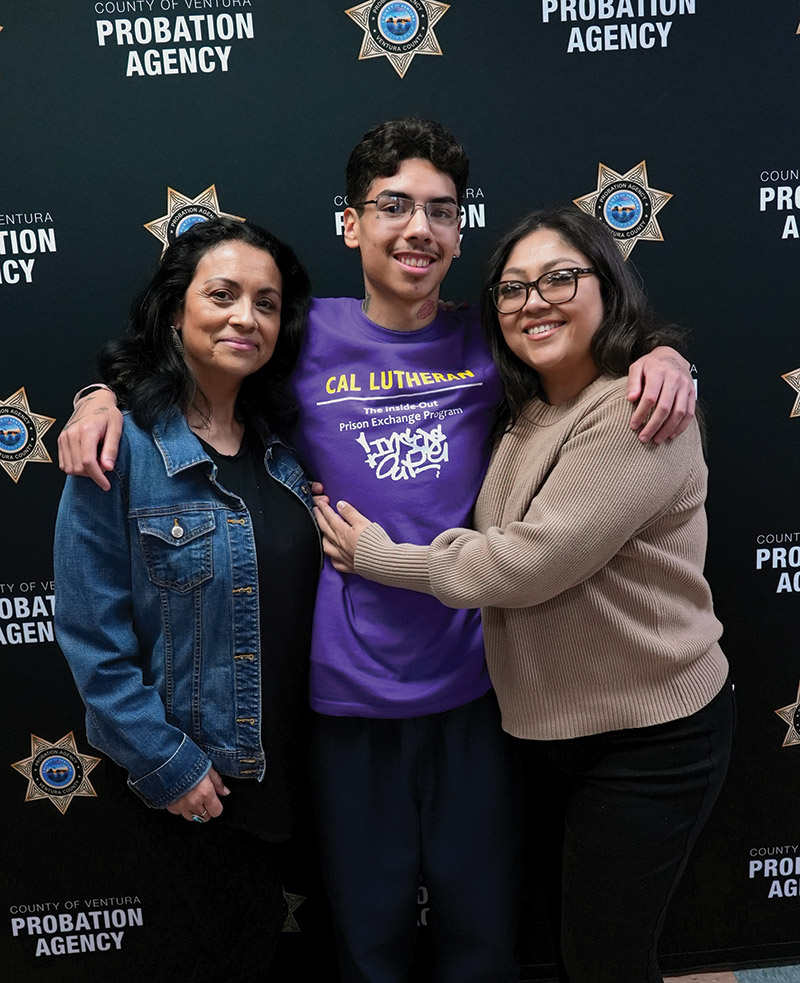
In 2016, she took a weeklong training session at a maximum-security prison near Philadelphia. She brought the program to Cal Lutheran and taught the first course in spring 2018 at Ventura County’s Todd Road Jail in Santa Paula, where the “insider” participants were 21 to 65.
COVID-19 restrictions interfered for a time. Jails reopened to visitors just as the juvenile correctional system was about to undergo a dramatic change. In mid-2023, California’s three remaining youth prisons closed after decades of activism by reformers and a steep drop in youth arrests.
Youthful offenders were transferred to local detention centers, where probation officers and collaborating organizations such as the Boys & Girls Club emphasized the development of skills and attitudes that would help the incarcerated young men succeed after release without relapsing into criminal activity.
“Generally, as human beings, we like to operate in binary fields,” Declan Tormey, division manager of the Ventura County juvenile facilities housing, said in an interview. “It’s easy to say a criminal is a bad person, and that’s that. But there’s much more nuance.”
The juvenile facility in Oxnard was initially meant to hold as many as 420 people, said Sam Cortez, the Ventura County Probation Agency’s public information officer. Now the population is about 60. Under California law, these offenders are released at age 25.
“That’s why we work on rehabilitating as much as we can from the time they are booked until they are released,” Cortez said.
Consider Matthew, 18, who has been incarcerated for 2 1/2 years. In addition to the Inside-Out program, he has taken other online community college classes. He is majoring in psychology and social and behavioral sciences and hopes to become an advocate for kids in the Ventura County neighborhood where he grew up.
“I’m still working on being able to move past the label of criminal … the label of someone who’s a bad person,” he said. “My main focus is on rehabilitation, being back in society and being able to be a support system for youth in the community.”
“Outsider” Kelly Alexander ’25 enrolled in the Inside-Out program in her final term at Cal Lutheran. She now attends the University of San Diego and hopes to become a lawyer.
“We are all humans,” she said. “We all make mistakes. These mistakes don’t define you. The best answer will never be just to incarcerate people.”
Sadie Rico ’25, a sociology and criminology major who also took the course as a senior, had a particularly poignant perspective. She grew up in Fillmore, California, without her father, who was serving time in a California prison.
“I had to grow up and keep going on with my life,” she said in an interview. “I just wish he had been there.”
He has since been released, and they are working to build a relationship.
When Rico first signed up for the Inside-Out class, some friends on campus expressed skepticism about learning alongside incarcerated people. Her dad, on the other hand, was pleased.
“That’s what humanity needs to do,” he told her. In the May closing ceremony for the Inside-Out class, she read aloud “Blueprint Daughter,” the poem she wrote about coming of age without his regular influence. These are excerpts:
You never wanted to grow, / Until I grew older,
And as time separated us, / My shoulders got colder,
…
My father is resilient / I’m so very proud,
He had every reason to give up, / And kept his promises he vowed
I’m graduating from college, / And it’s been some years,
But we can never go back, / To fix those childhood tears.
During the last few frenetic weeks, “insiders” and “outsiders” collaborated in small groups on an assignment to conceive of programs that could help the young incarcerated men re-enter society.
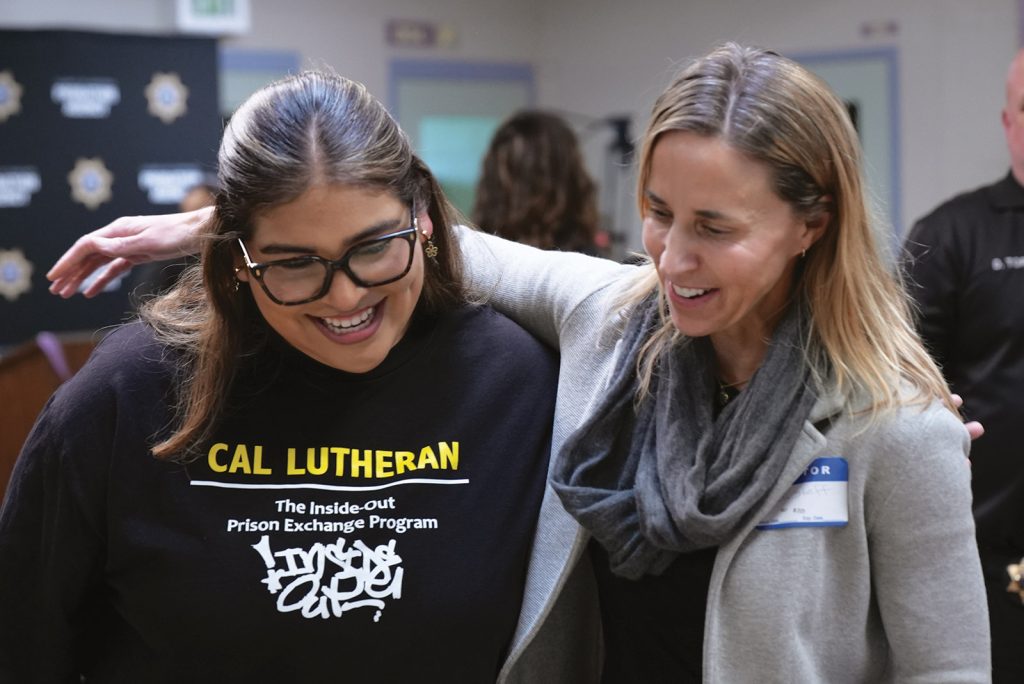
Desiree Hernandez ’25, who completed the course in her final semester before graduating with a degree in criminology and criminal justice, worked with her team on what they called the Five Pillar Project, which aims to reduce recidivism and ensure that formerly incarcerated young men have the support they need to succeed in the outside world. This could include help with obtaining a driver’s license, securing housing and applying for jobs.
Inspired by the Inside-Out program, she has applied to work with the Boys & Girls Club at the Oxnard juvenile facility and is considering becoming a probation officer or pursuing a master’s degree. She might even try to form a Five Pillar Project nonprofit.
“I learned so much from (the ‘insiders’),” Hernandez said. “They have so much potential.”